
Guides / Numbers 0 to 10
Numbers 0 to 10Number formation rhymes for 0 to 10
A number formation rhyme is a few words to say while your child writes a number, describing where the pencil starts and which way it goes. The words follow the movement, so the rhyme becomes a little reminder your child can say to themselves when they're writing on their own.
Here is a rhyme for each number from 0 to 10. They match the way numbers are usually taught in UK schools, where almost every number starts at the top.
A rhyme for every number
- 0: "Start at the top, go round like a ball, back where you started: zero, that's all!" Go round to the left (anticlockwise) and join up at the top.
- 1: "Start at the top, then down we go: one straight line, nice and slow."
- 2: "Round the top and down the slide, then along the bottom, nice and wide."
- 3: "Round to the middle, round to the end: three has two bumps, my friend!"
- 4: "Down and across, then lift and go: a long line down makes four, you know!" The pencil comes off the paper before the last line.
- 5: "Down, then round the tummy, lift up and add a hat: five, just like that!" The hat goes on last, starting from the top of the first line.
- 6: "Curve down and round, a loop on the ground: six is found!"
- 7: "Across the top and a long slide down: seven, the longest slide in town!"
- 8: "Make an S, but don't stop yet: back up to the top, and eight is set!" Start at the top and go left first.
- 9: "Round to the left, then straight down the line: that's how we write a number nine!"
- 10: "A one, then a zero, side by side: that makes ten, say it with pride!"
How to use the rhymes
- Say the rhyme while you write the number slowly, so your child sees the words and the pencil move together.
- Write it big in the air together, saying the rhyme as you go.
- Trace it with a finger: on a big dotted number, in sand or flour, or on your child's back for them to guess.
- Trace it with a pencil, starting at the start dot and following the arrows, still saying the words.
- Write it alone. If a number comes out backwards, say the first line of the rhyme together and check where it starts.
Keep the words the same
Choose one rhyme for each number and stick with it, so the words always go with the same movement. If your child's school or nursery uses its own rhymes, use theirs at home too. Some schools teach 4 or 5 a little differently, and that's fine: what matters is that your child starts in the same place and makes the same movement every time.
There's no need to learn them in counting order either. Straight-line numbers (1, 4 and 7) are a gentle start, then round ones (0, 6 and 9), then the curvy ones (2, 3 and 5), with 8 last.
Count as well as write
A number means more when it goes with a real amount. After writing a 3, count three spoons, three steps or three grapes. Our free worksheets have a ten frame of pictures to count on every number page, so writing and counting happen side by side.
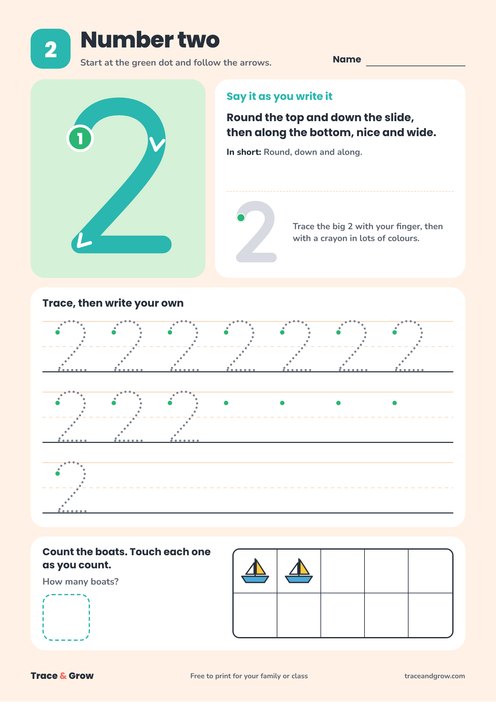
Free number formation worksheets 0–10
A page for every number from 0 to 10, with start dots, numbered arrows, a rhyme to say and pictures to count, plus a certificate.
When you want more pages
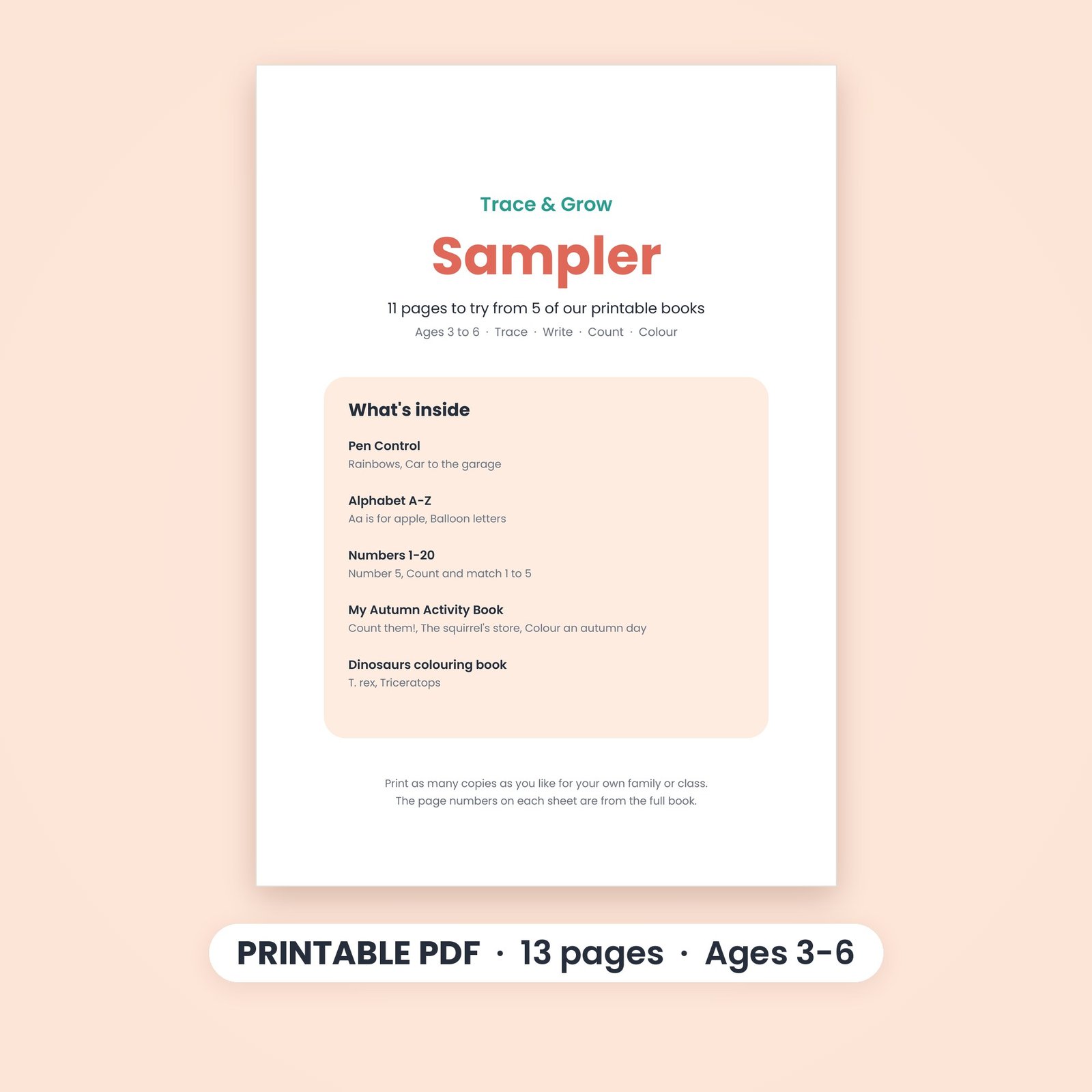 Try us for £1 · ages 3–6
Starter Sampler
11 real pages from five of our books, different from the free ones, to print at home. One per order.
See the sampler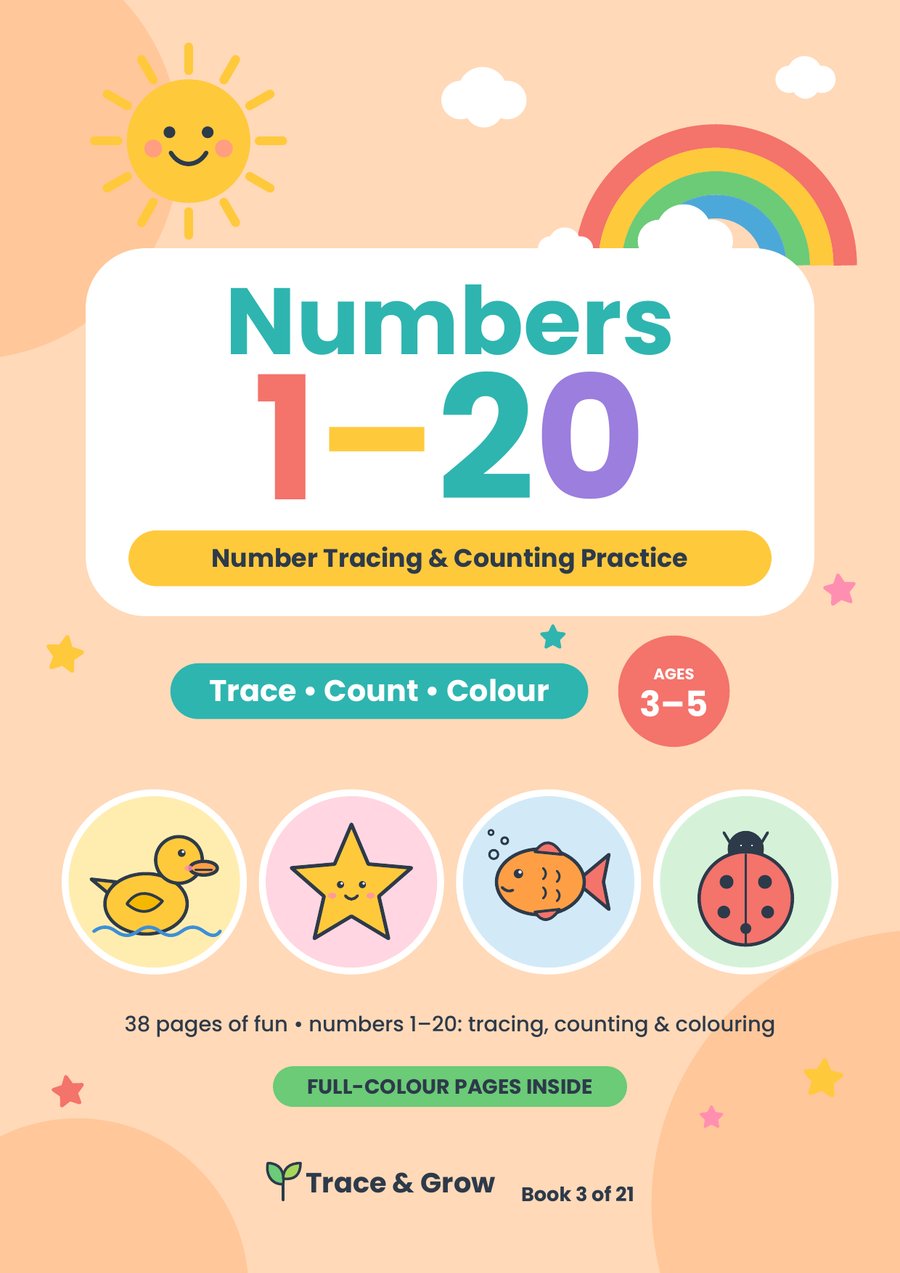 Ages 3–5
Numbers 1–20
Dotted numbers 1 to 20 with start dots and arrows, ten frames, counting, matching, number words and a certificate.
See the book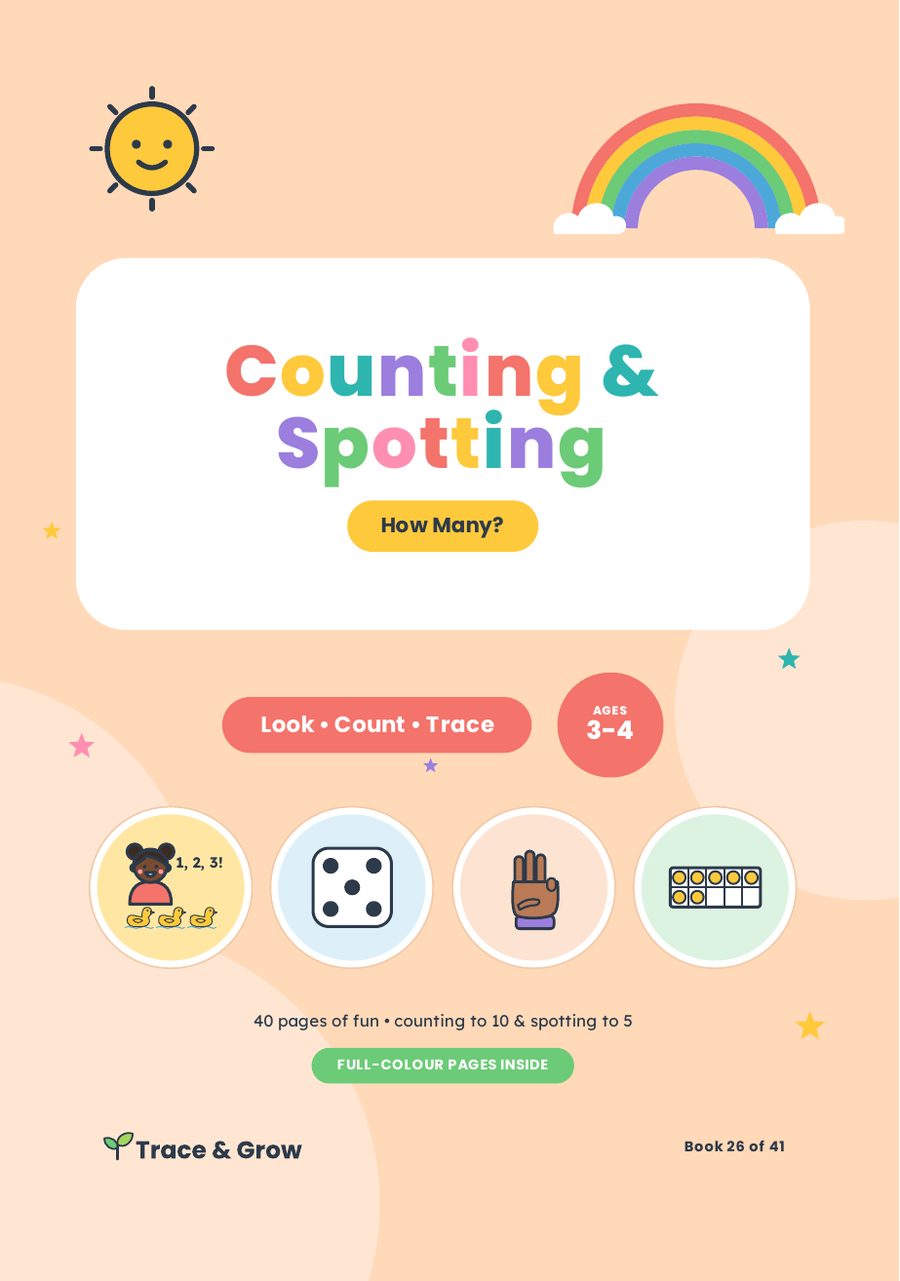 Ages 3–4
Counting & Spotting
A very first maths book: touch and count, spot 1 to 5 at a glance, more and fewer, and tracing 0 to 10.
See the book Ages 3–5
5-Minute Counting
One short counting page a day for 30 days, from numbers to 10 and then to 20, with numeral tracing.
See the bookQuestions parents ask
What are number formation rhymes?
Short rhymes that describe how to write each number: where the pencil starts and which way it moves. Saying the rhyme while writing gives children words to remember the movement by.
Which number formation rhymes do schools use?
There's no single official set, and schools and nurseries often have their own. If your child's school uses particular rhymes, use the same ones at home so the words always match.
Where should each number start?
Almost every number starts at the top. 0 goes round anticlockwise from the top, 4 and 5 need the pencil lifted for a second stroke, and 8 starts at the top and goes left first.
Is it normal for children to write numbers backwards?
Yes, numbers such as 2, 3, 5, 7 and 9 are often written backwards while children are learning. A friendly reminder of where the number starts usually works better than a correction.
Read next
More guides
- Tracing worksheets for 3 year olds: where to start
- Pre-writing shapes and patterns: what to practise before letters
- Phase 2 phonics letter formation: tracing s, a, t, p and the first sounds
- Handwriting practice for Reception: a calm routine for home
- b and d mix-ups: simple tricks and worksheets that help
- Visual timetable for home: how to make one work
- Arabic letter forms: the beginning, middle and end shapes
- How to teach a child to write their name
Get a new free page every month
Join the list for a printable star chart, 10% off books in your first order (not the UK delivery included in each price) and a monthly email with new free pages. Unsubscribe any time.